

product feature
LitifyAI Drafting
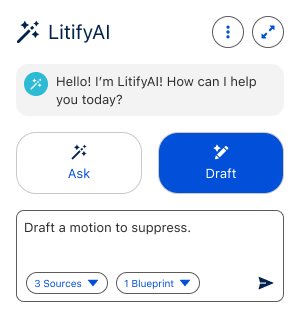
LitifyAI Drafting is an AI-assisted document drafting experience that helps legal teams move faster using case information already stored in Litify.
Role: Product Designer
Product: Docrio Document Management
Focus: Product discovery, customer research, UX strategy, interaction design, prototyping
Platform: Salesforce-based legal technology
The Challenge
Document creation is a core part of legal work, but drafting often requires users to gather information from multiple records, documents, and systems before they ever begin writing.
Our team had already been exploring opportunities to improve document generation within Docrio when the market began shifting quickly toward generative AI.
The question became bigger than how we could improve an existing workflow.
We needed to understand where AI could provide meaningful value to legal professionals, what customers would trust it to do, and how Litify’s existing case data could make the experience more useful than a standalone AI writing tool.
My role
I worked across discovery and product design to help define what an AI-assisted drafting experience should become.
My responsibilities included:
Customer outreach and interviews
Synthesizing research findings
Identifying product opportunities
Translating customer needs into design requirements
UX and interaction design
Prototyping
Collaborating with Product and Engineering as the concept evolved
Starting with the problem, not the technology.
Our discovery work began before AI became the focus.
For roughly a year, we had been investigating how legal teams created documents, where existing document-generation workflows fell short, and which parts of the process created the most friction.
As generative AI entered the competitive landscape, we expanded the research.
Rather than beginning with the assumption that customers wanted AI, I wanted to understand where they saw value and where they had concerns.
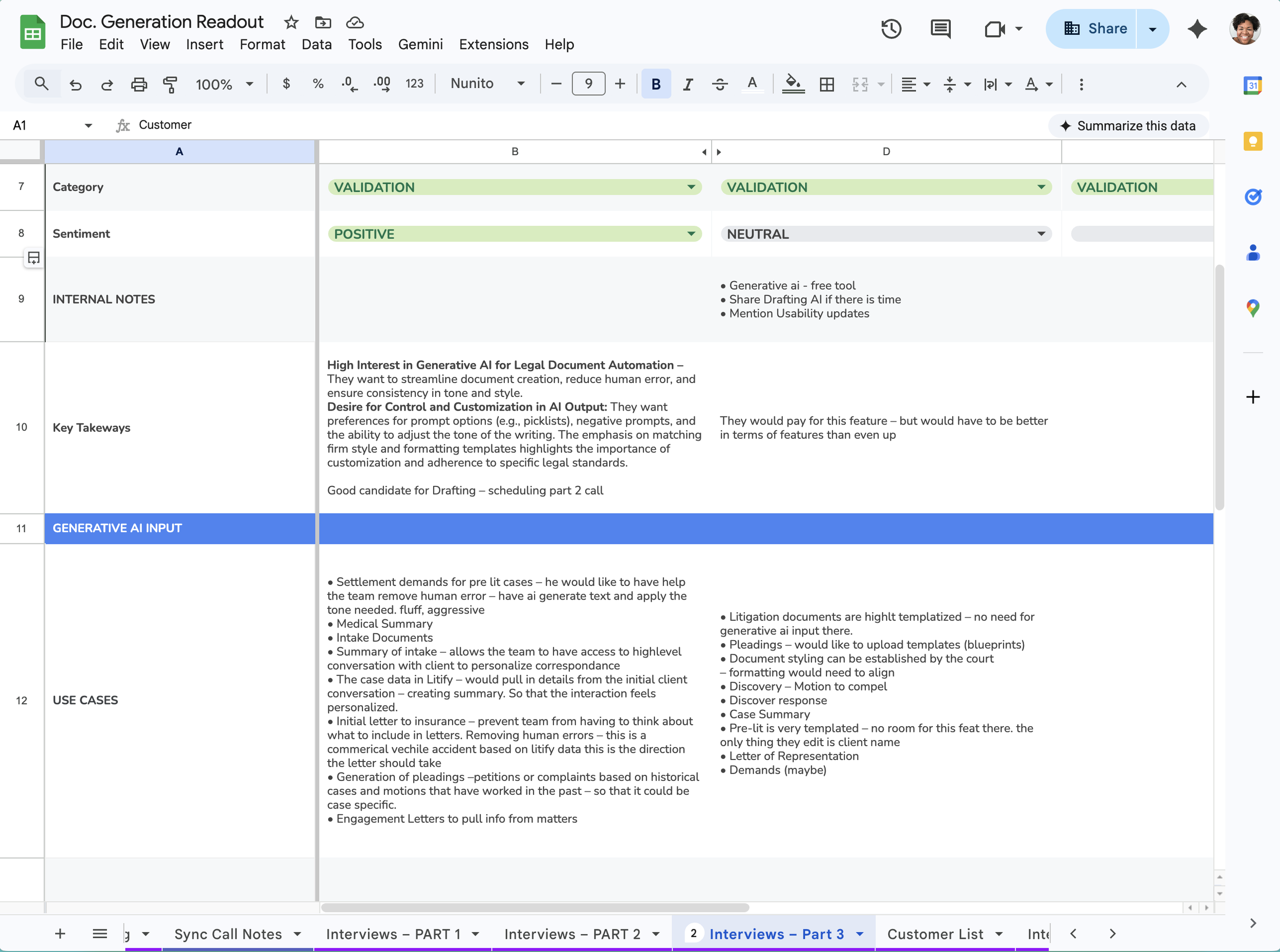
I reached out to more than 100 customers and conducted eight in-depth interviews with legal professionals.
What I learned
These findings pointed to a clear opportunity:
use Litify’s structured case data and existing document workflows to help users begin drafting faster while keeping legal professionals in control of the final document.
-
Legal teams already stored valuable case information in Litify. Asking users to copy that information into another tool would create another disconnected workflow, so existing case data became central to the experience.
-
Customers wanted AI to reduce repetitive writing and information gathering, but legal work leaves little room for incorrect names, dates, or case details. The experience needed to make drafting faster without asking users to sacrifice confidence in the information being generated.
-
Research pointed toward an assisted workflow rather than fully automated document creation. Users expected AI to give them a strong starting point, while leaving them responsible for reviewing, refining, and deciding what ultimately became part of the final document.
Designing the LitifyAI drafting experience.
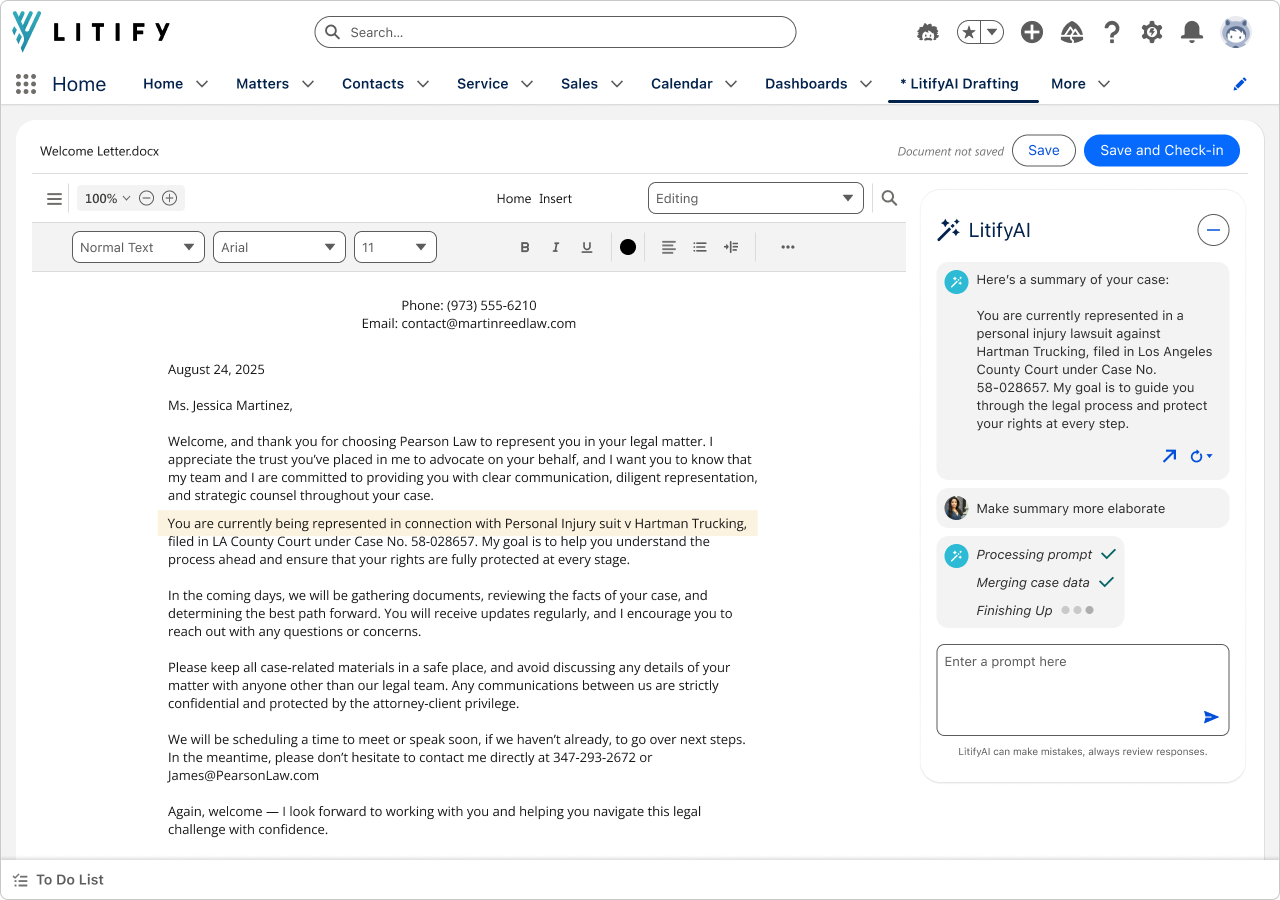
The experience needed to make generative AI useful without asking legal professionals to learn a new way of working.
Instead of centering the interface around prompting, I designed the workflow around a task users already understood: creating a legal document. Litify could use the matter, contact, and case information already stored in the platform to give the AI meaningful context and reduce the amount of information users needed to enter manually.
The workflow used existing case information to generate a starting point, then gave users space to review, refine, and shape the final document themselves.
That balance became central to the experience. The system provided enough structure and context to make drafting faster, while keeping the legal professional in control of the final content.
The result was an AI-assisted workflow embedded directly into Litify, rather than a separate AI tool users had to learn, populate, and manage outside their existing process.
The Outcome
The project introduced AI-assisted drafting into Litify’s document management experience, giving legal professionals a faster way to begin documents using information already stored in the platform.
The research also shaped Litify’s broader approach to generative AI. Instead of treating AI as a standalone feature, we focused on opportunities where existing case context, repetitive work, and user control created clear customer value.